This Global Battle Field Management Systems market elaborate report, compiled by Market Research Globe, offers a summary study on regional forecast, business size, and associated revenue estimations. The Battle Field Management Systems report more emphasizes primary challenges and growth trends adopted by leading makers of the market.
The Battle Field Management Systems market mentioned within the report has all the informative necessary details like the economic techniques, product provide and demand, applications, future forecast, and growth and development factors mentioned. The geographical and Battle Field Management Systems industrial dominance is predicted to assist the market carve out a reputation for itself on a world scale. The topological bifurcations also are a Battle Field Management Systems business growth benefiter market plans to strategically use to realize dominance.
For Players Segments, the Report Comprises of Global Players:
The Battle Field Management Systems report forecast the market size for varied segments, by key region. The report give elaborate data concerning the most important factors (drivers, restraints, opportunities, and challenges) influencing the expansion of the Battle Field Management Systems market and opportunities within the overall Battle Field Management Systems market for stakeholders by distinguishing the high-growth segments.
Why do you have to obtain Global Battle Field Management Systems Market Report?
Build business strategy by distinguishing the high global Battle Field Management Systems growth and enticing market classes;
Develop Battle Field Management Systems competitive strategy supported competitive landscape;
Design capital Battle Field Management Systems investment ways supported forecasted high potential segments;
Identify potential Battle Field Management Systems business partners, acquisition targets and business consumers;
Plan for a replacement Battle Field Management Systems product launch and inventory beforehand;
Prepare management and Battle Field Management Systems strategic shows mistreatment the market information;
Alphabet(NASDAQ:GOOG)(NASDAQ:GOOGL) has been testing a competitor to Apple(NASDAQ:AAPL) Arcade, the subscription mobile gaming service that the Cupertino tech giant launched last week for $5 per month. Apple Arcade gives subscribers access to a catalog of over 100 premium games that have no ads or in-app purchases, and the company is offering a one-month free trial to get users on board. Alphabet's offering, called Google Play Pass, is officially launching today.
There are some notable differences between Apple Arcade and Google Play Pass.
It's not just games
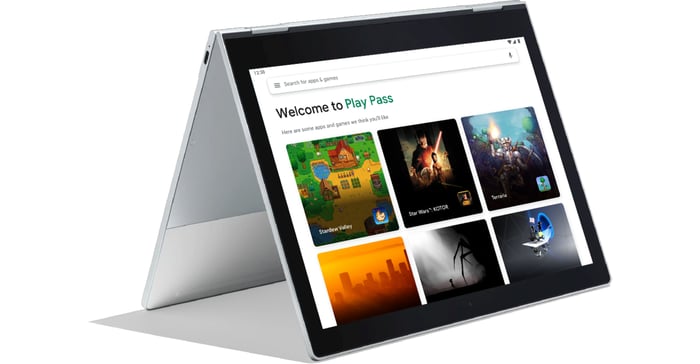
For starters, Google Play Pass includes more than just games. Various other non-gaming apps like AccuWeather and Pic Stitch will be included in the service, with the total library consisting of over 350 games and apps at launch. More games and apps will be added to the collection on a monthly basis, much like Apple Arcade. The content will be accessible from Android devices, as well as laptops and tablets running Chrome OS that have the Google Play Store.
Google Play Pass. Image source: Google.
Both Apple Arcade and Google Play Pass can be shared within a family. Each user within a family will access the service individually, so each person's activity will not affect others. Google is offering a 10-day free trial and running a launch promotion offering a year's worth of service for $2 per month. There's no mention of exclusive titles, so Google is really just bundling some of the most popular cross-platform games and apps on Android into a subscription service.
Google Play Pass is a different service than Stadia, the $10-per-month cloud-based game-streaming platform that Google detailed earlier this year. Stadia, which launches in November, is positioned more as a competitor to high-end game consoles and PCs.
Android monetization is weaker than iOS
Google is being more aggressive than Apple because it knows that it's coming from behind. While Android is expected to grab an estimated 87% market share of the global smartphone market this year, according to recent estimates from IDC, the platform lags iOS in terms of monetization.
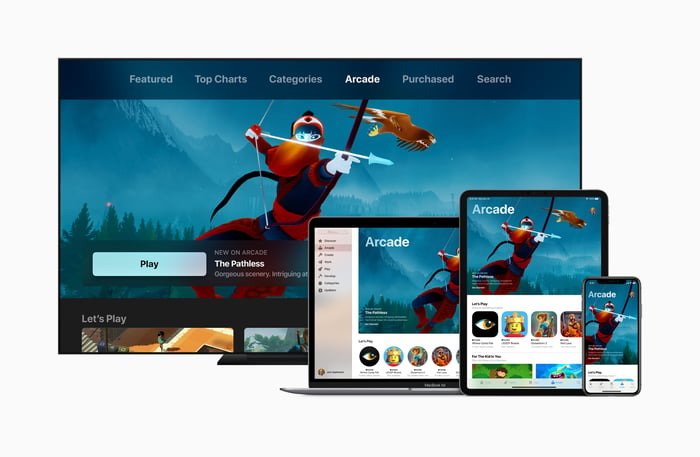
Apple Arcade. Image source: Apple.
A separate App Annie report this summer estimated that Google Play represents just 36% of mobile consumer spending even though the storefront accounts for 72% of downloads. The flip side of those metrics: iOS grabs 64% of mobile consumer spending with just 28% of downloads.
Apple has invested an estimated $500 million into funding Apple Arcade titles, many of which are exclusive to iOS. Google is throwing (presumably less) money at trying to compete with Apple Arcade, hoping to improve monetization on its platform using the same model.
Plus, the Anker PowerCore 10000 Redux portable charger offers quick, safe charging for both large and small devices, like wearables, and Xerox's new multifunction printer enables wireless printing without a router.
Dell
Data Command
The new Dell Precision 7740 laptop has a 17.3-inch screen and is available with either a Titan Gray aluminum or carbon fiber cover. It is virtual reality- and artificial intelligence-ready, designed for demanding data and graphics use, from complex CAD designs to machine learning projects and AI infrastructure transitions. The 7740 features either the latest Intel Xeon E or 9th Gen Intel Core 8-core processor, and comes with up to 128 GB of ECC memory, and up to 8 TB of PCIe SSD storage. The latest NVIDIA Quadro RTX graphics deliver real-time ray tracing with AI-based graphics acceleration. Its display options include a new 17.3-inch UltraSharp UHD IGZO display with 100 percent Adobe color gamut. www.dell.com
Power Source
Anker's PowerCore 10000 Redux is a 10,000-milliamp-hour (mAh) portable charger that's light and compact. It weighs slightly more than a baseball, and can charge a phone twice and most tablets once before needing recharging itself. The company's PowerIQ and VoltageBoost technologies combine to ensure a quick charge, up to 2.4 amps. The charger offers surge protection and short circuit prevention. The device's trickle-charging mode is designed to deliver a fast and safe charge for every device, including small items and wearables. www.anker.com
Print Power
Xerox announced the B215 multifunction printer featuring Wi-Fi Direct technology that enables wireless printing without a router and mobile print functionality with Apple AirPrint, Google Cloud Print, Mopria and Android support. The device has a 600 MHz processor and prints up to 31 pages per minute, yielding high-resolution 1200 x 1200 dpi enhanced image quality. Photocopy resolution is up to 600 x 600 dpi. The B215 includes a 3.5-inch touchscreen and can copy, email, fax, print and scan. The printer also allows collation, booklet creation and poster printing. www.xerox.com
Next-generation consoles will 'go green' as PlayStation, Xbox, Stadia, and more partner with the United Nations to tackle climate change.
The climate change initiative has gained support from 21 companies that have joined the UN's new Playing For The Planet Alliance. Each platform has formally pledged to raise awareness of climate change and proactively work to reduce pollution.
Microsoft and Sony have promised to help save the planet with plans for carbon-neutral Xbox units and a low-power suspension mode for the PlayStation 5.
The UN Environment website contains a record of all promises the companies have pledged. Within the exhaustive list is the pledge from Sony indicating that the next-generation PlayStation console will have a low-power suspend mode.
In a recent PlayStation Blog post, President and CEO Jim Ryan confirmed the mode will consume less power than the PS4's, stating: "If just one million users enable this feature, it would save equivalent to the average electricity use of 1,000 US homes."
Microsoft has revealed a new manufacturing project that aims to reduce supply chain emissions by 30% by 2030. Additionally, the platform holder will certify that 825,000 Xbox consoles are carbon neutral as part of a pilot program.
The Google Stadia team will also aim to produce a guide for sustainable game development. The company has promised to fund research into implementing 'green nudges' into gameplay.
The companies on board so far are Sony Interactive Entertainment, Microsoft, Google Stadia, Ubisoft, Sports Interactive, Twitch, Niantic, Supercell, Playmob, Rovio, Sybo, Space Ape, Wild Works, Green Man Gaming, Creative Mobile, Reliance Games, iDreamSky, E-Line Media, Strange Loop, Pixelberry, and Internet of Elephants.
The UN has partnered with these companies because it estimates they have a combined audience of 970 million players. Furthermore, the planned initiatives from the Climate Action Summit will reduce CO2 emissions by 30 million tonnes by 2030.
For all the latest news from the world of single-player gaming, be sure to follow OnlySP on Facebook, Twitter, and YouTube. Also, be sure to join the discussion in the community Discord server.
Google on Monday launched Play Pass, a monthly subscription service that gives people access to a library of games and other apps on Google's Play Store, as the search giant experiments with new pricing models for its products. The service, which costs $4.99, includes more than 350 apps and games, including Monument Valley, Risk and Star Wars: Knights of the Old Republic. But Google said it wants the service to go further, so it's also bundling other types of health, fitness and photography apps. That includes photo retouching, weather and camera apps.
Play Pass is a $4.99 subscription service.
Google
"Games are super important, but we're going beyond that," Austin Shoemaker, a group product manager at Google, said in an interview last week. "It doesn't just appeal to hardcore gamers."
Play Pass is similar to Apple Arcade, a service from the iPhone maker that launched last week and also costs $4.99. Apple's offering, though, focuses solely on games and has a library of about 100 titles. Asked about the comparison to Apple Arcade, Shoemaker didn't specifically address the competitor. He did say, though, that the company thinks of Play Pass as "much broader."
The Play Pass launch comes as Google makes a big push into gaming. In November, the search giant is releasing its Stadia platform, a service that lets people stream games from the cloud instead of playing them on a console. Tech giants and media companies have also been more broadly experimenting with subscription services. For example, firms including Disney and NBC have announced plans for their own streaming video services. Meanwhile, Google has been building out Google One, a subscription service for consumers that gives people more storage for the company's suite of apps, including Google Photos and Drive.
Google says the Play Pass service includes more than 350 games and other apps.
Google
Play Pass also gets rid of ads, in-app purchases and paywalls. For now, Google is offering a promotion that lets people pay $1.99 per month for the first year, with a 10-day free trial. Google will also let people share the subscription with up to five family members.
To use Play Pass, subscribers will see a new tab with a ticket logo in the Google Play app. The page includes featured apps and recommendations that have been curated for the service. Google said it will share subscription revenue with app developers, but declined to provide details on how the money would be split.
Shoemaker said the service won't come with any exclusive content, but that could change in the future.
This article was originally published on Sept. 23, 2019 and has since been updated.
Now playing:Watch this: Stadia announcement: All the cool games previewed
As cloud gaming continues its upward trajectory and prepares to dominate the gaming landscape, markets around the world are anticipating its impact. In particular, the Asian game market -- the largest in the world -- is expected to see enormous growth from cloud gaming. According to a new report from market analyst group Niko Partners, cloud gaming in Asia is expected to generate $3 billion by 2023.
"Cloud gaming will be of tremendous benefit to gamers who will have access to a large number of high quality titles without the need for expensive hardware," Niko Partners founder Lisa said in a statement. "Developers, publishers, and platforms all profit as well with greater reach and more ways to monetize, however the companies that own the most parts of the value chain from IP to infrastructure stand to benefit the most. And as with so many other sectors of gaming, Asia is leading the way."
According to the report, cloud services will reach approximately 3 million gamers in Asia by next year, with that number rising to 60 million in 2023, and 500 million by 2028. Niko expects that mobile gamers will make up the majority of consumers impacted, as they're the largest segment of the market.
"Consoles are a niche market in Asia outside Japan, and we expect this to remain the case moving into the next generation," Niko Partners senior analyst Daniel Ahmad told GameDaily. "We believe that cloud gaming can expand the console playing audience by bringing high quality console games to PC and mobile gamers via cloud. Microsoft has already partnered with SK Telecom to trial its XCloud console cloud game service to over 1 million 5G users on the network."
Widespread adoption of the cloud is likely to be driven by advances in the technology behind it. While previous endeavors into cloud gaming--services like OnLive and Gaikai--hinted at its potential, they were badly bottlenecked by the low bandwidth available at the time. Now, with the advent of 5G technology, Niko expects those roadblocks to disappear, assuming cloud gaming continues to see substantial investment.
"5G and new business models for cloud gaming platforms will be the main drivers of growth through 2023," Ahmad said. "5G, along with edge computing, will enable mobile gamers to play cloud games at high resolutions and with low latency, providing an experience that cloud games could not previously reach. New business models for cloud gaming platforms, such as free-to-play and time-based fee platforms, will allow cloud games to reach a much larger audience on PC and Mobile."
The cloud has been the target of tech giants like Microsoft and Google. For years, Azure cloud services have been one of the most lucrative sectors of Microsoft's business, and it's grown by more than 73% over the last year. Clearly, doubling down on the cloud and further tapping the Asian market is in the best interest for Microsoft.
The upcoming launch of its Stadia gaming service illustrates Google's confidence in cloud gaming. The company also already boasts a substantial footprint in the Asian market, and will likely continue to grow over the coming years. However, Google is one of several companies prohibited from operating in China, making the country an enormous untapped vein of cloud users for the U.S. tech giant.
While the cloud is less of a focus for Sony, it's made its own moves into the industry. In May, it announced plans to work with Microsoft to further cloud gaming, and analyst group IHS Market anticipates that PS Now will be important to Sony's success in the cloud.
Chinese tech giant Tencent has been building its cloud gaming division for some time now, and even owns an entirely separate company dedicated to the technology. Tencent Cloud has been making efforts to expand westward in recent years, and will likely continue to grow as more and more consumers flock to cloud gaming.
"We believe the best positioned cloud gaming companies will own multiple parts of the cloud gaming ecosystem," Ahmad said. "Tencent being the prime example due to its large library of self developed and licensed games, its strong distribution channels such as WeGame, WeChat, MyApp, and its cloud computing segment. Western cloud game companies can find success in Asia but may be limited by the popularity of business models they use, as well as regulations that restrict them from operating in certain countries, such as Google in China."
The Asian game market is the largest in the world, so we're likely to see some tough competition there moving forward. There's no denying the future of gaming will be inseparably tied to the cloud, and it's simply a matter of time before 5G technology makes a global impact. As platform barriers are removed and more consumers shift to cloud-based gaming, revenue is likely to skyrocket, making the industry more and more attractive for tech companies.
"5G is a killer app for cloud gaming and will grow the market significantly over the next few years in Asia," Ahmad said. "There is also a strong push from governments, publishers and developers to explore the 5G and cloud gaming market. We think that cloud gaming will reach mainstream by 2023 and go fully mass market by 2028 as developers move to create cloud-first games and platforms promote the convenience of cloud games."
From the videos of beautiful pets to quality time with family and friends, videos can capture it all. Nowadays, capturing a full HD video isn't climbing the Mt.Everest and even the dirt-cheap smartphones nowadays have support for recording FullHD or 1080p videos, thanks to today's technology. But if you capture videos a lot, it can quickly fill up the few Gigabyte of memory on your smartphone and it will eventually consume all the space on your external hard drive and other storage media whichever you have access to, quite soon.
But, Technology can solve a number of problems, and that's when the cloud storage services come into play. With cloud storage services, you can easily backup your videos, so that you can get more room for some new ones.
Today, most cloud storage services offer a few gigabytes of storage for free, and later you will have to pay a significant amount of money to upgrade your storage space in order to get an adequate backup space for all your videos. But, unless you are recording something really important, or you are not a professional, spending some pennies just to get some extra space on your cloud storage service will make you regret your decision quite soon.
There are a number of ways, you can backup or upload videos to a number of services for free and I will talk about three of the best ones here. As I will discuss the 3 tricks to backup all your videos and for free, you might not get a similar level of convenience if you use some premium video or cloud storage services that are available.
So, without any further delay, let's get started with the three ways you can backup your personal videos for free.
Google Photos
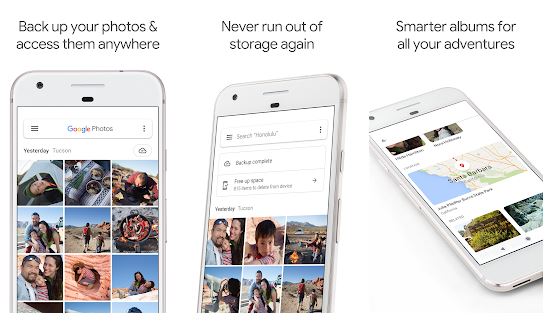
Android users already know about Google Photos, which is a service by Google. Besides, offering a gallery-like feature, Google Photos also acts as a server, where you can upload and backup all your photos and videos without paying a single penny.
Google Photos come with two backup options, where the first one will upload the photos and videos in its original form, where the uploaded photos and videos will be counted against your free 15 GB quota or the Google Drive storage.
However, if you go for high-quality storage, all your photos and videos will be backed up without any noticeable decrease in quality and you will get unlimited storage for photos if you opt for optimized quality upload.
If you are uploading photos all the photos, they will be compressed to 16 MP, and talking about videos, all the videos that are uploaded to the platform will be compressed to 1080p resolution.
It means if your photos have a resolution of 16 megapixels or less, and for videos, they have a resolution of 1080p or less, you will not have to worry at all.
If the photos that you have, are higher than 16 MP and for videos, it is better than 1080p, they will be resized back to 16 MP and 1080p respectively. Now you can use Google Photos to back up photos and videos even from your computer.
You just have to choose the folders, which need to be backed up and all the photos and videos that you put in that particular directory or folder will automatically sync with Google Photos and you can access them from anywhere.
YouTube
YouTube doesn't require any introduction. We all love YouTube for the handful of video creations it has to offer from creators worldwide. Even if you are not a creator, but is into watching YouTube videos, you can use YouTube as a tool to backup all your local videos completely for free.
Don't worry, there is an option, which will hide all the videos that you have uploaded from the rest of the world if you upload them as private videos. You can choose whether a video will be public or private at the time of uploading the video or later on after the video is uploaded to the platform.
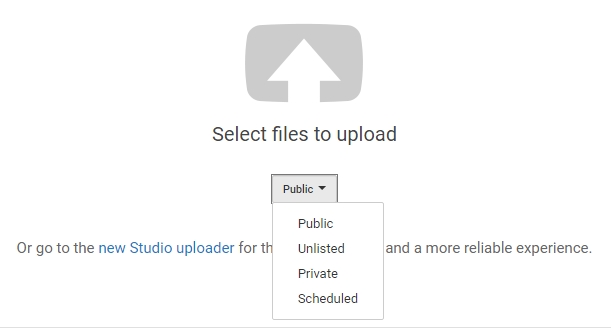
Video can be uploaded to YouTube in 3 modes of visibility, the public mode, private mode, and unlisted mode.
Public videos are all those videos, which we all watch on YouTube.
Private videos will be visible only to you and unlisted videos are those videos that will not be listed in the search results, but anybody can watch them if they have the link. To upload a video on YouTube, simply click on the upload button on YouTube and start uploading the videos. But don't forget to change the visibility to private as shown in the screenshot below.
Once all your videos are uploaded to YouTube, you can even add them to multiple playlists so that you can easily access them whenever you need them.
One thing I have noticed with private videos and playlist on YouTube is that they load in a sluggish way, compared to public videos on YouTube. The reason behind it might be, the private videos don't fetch any kind of revenue to YouTube as it is only you who can watch them.
However, if your video has some copyrighted content you can sometimes find ads which is something that you should keep in mind.
Facebook
Just like YouTube, Facebook is again something that is known to everybody. You can upload your sweet moments with friends and family members and see a number of useful posts on the platform.
Just like on YouTube, you can upload videos to share them among your friends and family members. Similarly, you can even post videos to Facebook and change the visibility to private or 'Only me' so that it is not visible to anybody on Facebook.
Just like most other platforms, Facebook also compresses the video that you upload, but they are not clear about how the videos are compressed, just like Google Photos.
Just like YouTube, you can even upload 4K videos to Facebook. Unlike YouTube and Google Photos, I didn't find any option to add the videos to an album, but still, the videos will be there safe.
Once you feel like showing the videos to people in your friend list, or to the public, you can change the visibility any time, and share it with everybody, with just a single click.
So, those were the different ways you can upload your videos or back them up to online services without paying a single penny. All the options to upload your videos for free, that I have mentioned here should be lucrative to you. But you should take note of the fact that none of the services other than Google photos is backup service providers just like most cloud storage services that you can find everywhere.
So, their stands on private photos and videos can change anytime by adding a few more clauses to the terms and conditions. Thus, the good times can change anytime, and thus, better use the services with caution.
You can always go for some full-fledged backup services, which offer a handful of Gigabyte storage for free, which can be a sober option if you are looking for more convenience.
Even if the terms and conditions change anytime in the future, there should be enough time for you to download all your photos and videos that are hidden from others.
That was all about how you can backup all your photos and videos for free. Do you know any other great service that offers unlimited photo and video backup service across multiple platforms? I will like to know about it in the comment section below.
If something seems too good to be true, it probably is. There appears to be a bug in the Google Cloud Platform online user interface that may lead engineers into thinking they're renting GPU-accelerated virtual machines for free, when, really, they're not.
Anyone hoodwinked by the glitch will realize the Compute Engine resource is not gratis, and actually costing potentially several hundreds of dollars a month, the next time they look at their cloud bill. It's not going to bankrupt anyone, but it is something that you may trip up over, so consider this a heads up. You may even encounter a similar gremlin in future, or on another cloud platform. It can happen.
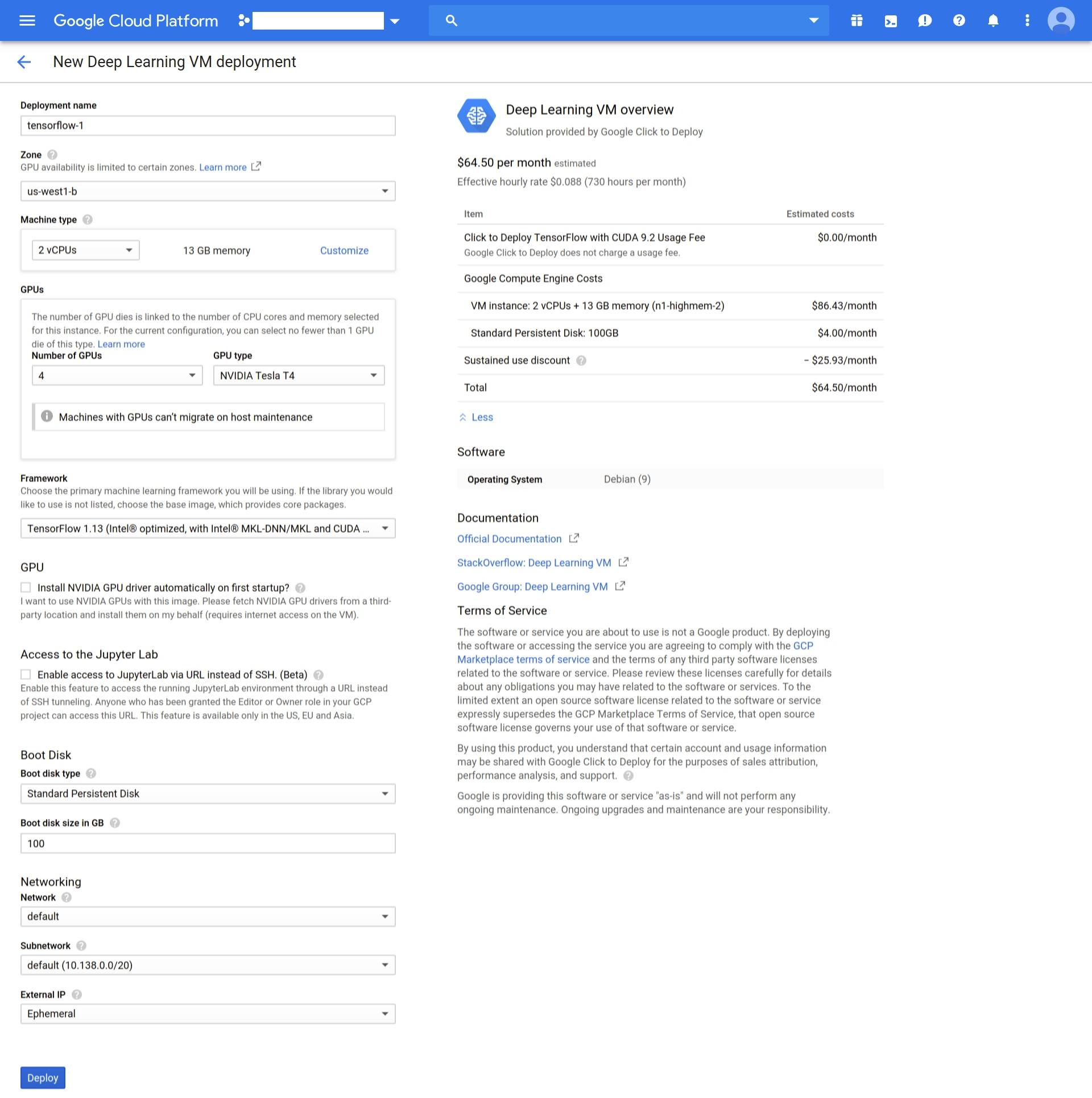
We found out about the bug from Soufian Salim, an AI engineer at French software startup Bee4win, who wanted to train a neural network model using Nvidia's spanking new Tesla T4 GPUs. He had spun up a virtual machine instance from the Google Cloud marketplace – specifically, the AI Platform Deep Learning VM Image – and configured it to use a bunch of T4s to speed up calculations.
Here's a screenshot of his settings that he shared with The Register:
Virtual machine settings ... Image credit: Soufian Salim Click to enlarge any screenshot
You can see that he's configured the instance to use two CPUs with 13GB RAM, and four Tesla T4 GPUs, all for a reasonable price of $64.50 per month. The estimated charges tallied up on the right include the costs of using Google-hosted CPUs, memory, and a discount for being a frequent cloud customer, but there is no mention of the T4 GPUs. These should be listed on the page as they normally cost between $0.29 and $0.95 per hour per GPU, depending on the configuration and minus any discounts. Instead, nothing's shown, so they're free, er, right?
"Normally, a T4 should cost several hundred dollars [per month]," Salim told The Register earlier this week. "I think it's probably a [user interface] bug, according to documentation it should not be free. But I'm not 100 per cent sure. I have sent a bug report to the Google Cloud team."
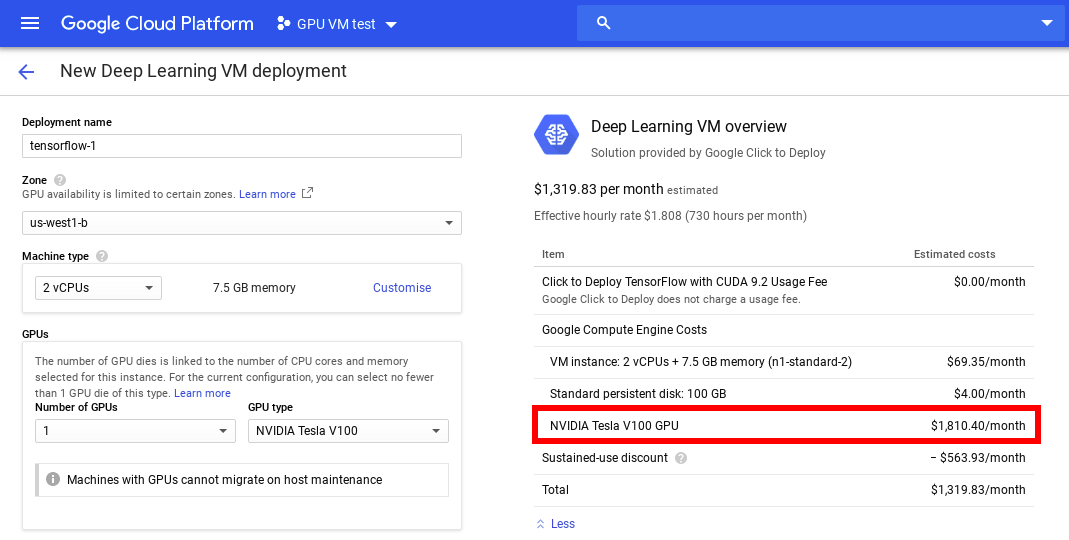
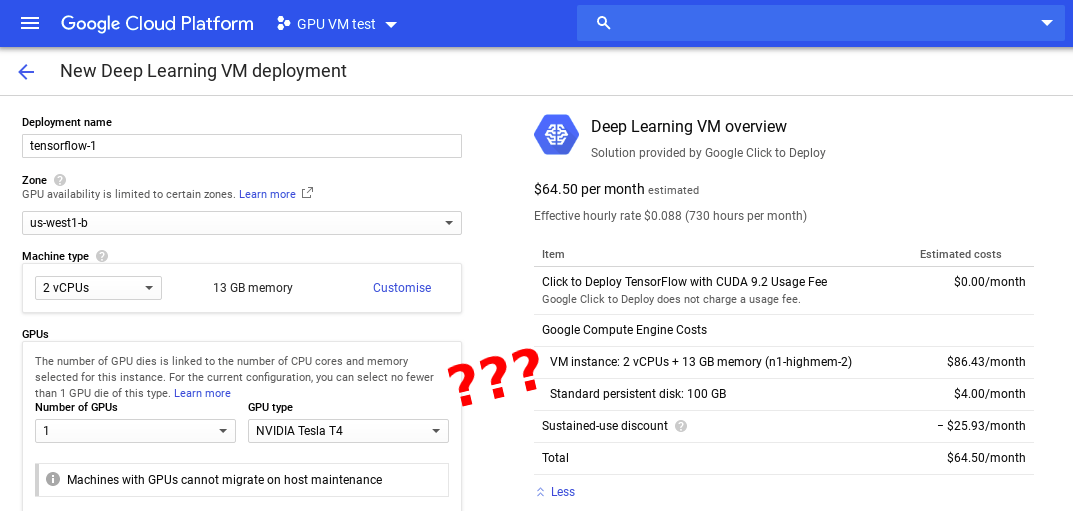
We tried to spin up our own deep-learning instance using the same settings, and found the same glitch, too. When we tried to use a different GPU model such as Nvidia's V100, a charge popped up on the estimated bill for the cloud-based hardware, and when we switched back to a T4, it disappeared again, as you can see from the screenshots below. That would suggest the T4s are free to rent, whereas the V100s are not.
Cost of V100 estimated on the right...
...but zilch when we used a T4
Google does offer free T4s on its Colaboratory platform. Here, developers can run specific AI models in Jupyter notebooks using Google's cloud resources at no charge at all. Salim said his model wasn't using the Colab service, however, and neither was our model. We're also aware that you can use T4s for free via certain non-AI promotions, such as within a BlazingSQL Colaboratory environment. These aren't production environments, though, and are for testing purposes, hence the freebie GPUs.
Salim told The Register he was training a neural network based on Google's BERT language model and deployed his virtual server on Tuesday morning. It was left running for over a day and a half, and it seemed to be behaving normally, he said.
A bug too good to be true
Salim's inkling that it was simply a user interface bug, and that he would eventually be billed by a backend system for the T4 GPUs, was later confirmed when he discovered that Bee4win was indeed charged for the rented graphics processors despite it not appearing on the estimated costs. "As I suspected, we were billed for the GPU, at about 0.9$/hour. It was an UI error," he told The Register on Thursday.
And a day after spinning up our own virtual machine, we checked our Google Cloud billing page, and found, yup, El Reg would be charged, too, for the T4s. Rather than be able to gleefully announce to the world that we'd found a way to get free Nvidia Tesla GPUs in production cloud instances, we found the hourly costs had caught up with us. Instead of quaffing martinis on expenses tonight, we shall instead be drinking tap water as, well, the money's gone on Google Cloud.
So, if you happen to see the same bug don't be tempted to spin up more T4 GPUs just because they look like they might be free, because they're not.
The problem hasn't been fixed, so be warned. A Google spokesperson told us on Friday: "We are aware that some customers are not seeing estimated charges for T4 GPUs on the marketplace web interface before creating virtual machines, and we are working to fix the pricing estimator." ®
When evaluating public cloud providers, it is easy to get hung up on the differences. AWS, Microsoft Azure, and Google Cloud each have their own terminology, pricing, service catalog, and purchasing variations. But do these differences ultimately matter?
Compute options
Though we are able to align comparable products across AWS, Azure, and Google Cloud, there are of course differences between these offerings. In fact, with the number of products and services available today (we've counted176 from AWS alone), comparing each is beyond the scope of this article.
For our purposes, we can compare what is still the core product for cloud service providers: compute. Compute products make upabout two thirds of most companies' cloud bills, so the similarities and differences here will account for the core of most users' cloud experiences.
Here's a brief comparison of the compute option features across cloud providers:
Of course, if you plan to make heavy use of a particular service, such as Function-as-a-Service/serverless, you'll want to do a detailed comparison of those offerings on their own.
Pricing
That covers functionality. How do the prices compare? One way to do this is by selecting a particular resource type, finding comparable versions across the cloud providers, and comparing prices. Here's an example of a few instances' costs as of this writing (all are Linux OS):
For more accurate results, pull up each cloud provider's price list. Of course, not all instance types will be as easy to compare across providers – especially once you get outside the core compute offerings into options that are more variable, more configurable, and perhaps even charged differently (in fact, AWS and Google actually chargeper second).
Note that AWS and Azure list distinct prices for instance types with the Windows OS, while Google Cloud adds aper-core license charge, on top of the base instance cost.
The table above represents the default On Demand pricing options. However, each provider offers a variety of methods to reduce these base costs, which we'll look at in the Purchasing Options section.
Terminology
At first glance, it may seem like the cloud providers each have a unique spread of offerings. But many of these products and services are quite similar once you get the names aligned. Here are a few examples:
Obviously, this is not a sign of substantive differences in offerings – and just goes to show that the providers are often more similar than it might appear at first glance.
Purchasing options
Comparisons of the myriad purchasing options are worth several articles on their own, so I'll keep it high level here. These are the most commonly used – and discussed – options to lower costs from the listed On Demand prices for AWS, Microsoft Azure, and Google Cloud.
Reservations
Each of the major cloud providers offers a way for customers to purchase compute capacity in advance in exchange for a discount:AWS Reserved Instances, Azure Reserved Virtual Machine Instances, andGoogle Committed Use discounts. There are a few interesting variations, for example, AWS offers an option to purchase "Convertible Reserved Instances", which allow reservations to be exchanged across families, operating systems, and instance sizes. On the other hand, Azure offers similar flexibility in their core Reserved VM option. Google Cloud's program is somewhat more flexible regarding resources, as customers must only select a number of vCPUs and memory, rather than a specific instance size and type.
What about if you change your mind? AWS users have the option to resell their reservations on a marketplace if they decide they're no longer needed, while Azure users will pay a penalty to cancel, and Google users cannot cancel.
Spot and preemptible instances
Another discounting mechanism is the idea ofspot instances in AWS,low-priority VMs in Azure, andpreemptible VMs, as they're called on Google. These options allow users to purchase unused capacity for a steep discount. The cost of this discount is that these instances can be interrupted (or perhaps Azure puts it best with their "evicted" term) in favor of higher priority demand – i.e. someone who paid more. For this reason, this pricing structure is best used for fault-tolerant applications and short-lived processes, such as financial modeling, rendering, and testing. While there are variations in the exact mechanisms for purchasing and using these instance types across clouds, they have similar discount amounts and use cases.
Sustained use discounts
Google Cloud Platform offers another cost-saving option that doesn't have a direct equivalent in AWS or Azure:Sustained Use Discounts. This is an automatic, built-in discount for compute capacity, giving you a larger percentage off the more you run the instance. Be aware that the GCP prices listed can be somewhat misleading, as a sustained use discount is already built in, assuming full-month usage – but it is nice to see the cloud provider looking after its customers and requiring no extra cost or work for this discount.
Contracts
A last sort of "purchasing option" is related to contract agreements. With all three major cloud providers, enterprise contracts are available. Typically, these are aimed at enterprise customers, and encourage large companies to commit to specific levels of usage and spend in exchange for an across-the-board discount – for example,AWS EDPs,Azure Enterprise Agreements. As these are not published options and will depend on the size of your infrastructure, your relationship with the cloud provider, etc., it's hard to say what impact this will have on your bill and how it will compare between clouds.
The 'it' factor
There's also just the pure perception of the differences between cloud providers.
For instance, some may perceive Azure as a bit stodgy, while Google Cloud seems slick but perhaps less performant than AWS. Some appreciate AWS and Azure's enterprise support more and find Google Cloud lacking here, but this is changing as Google onboards more large customers and focuses on enterprise compatibility.
There are also perceptions regarding ease of use, but actually, we find these to be most affected by the platform you're used to using. Ultimately, whatever you're most familiar with is going to be the easiest – and any can be learned.
Do the differences really matter?
On some of the factors we went through above, the cloud providers do have variations. But on many variables, the providers and their offerings are so similar as to be equivalent. If there's a particular area that's especially important to your business (such as serverless, or integration with Microsoft applications), you may find that it becomes the deciding factor.
The fact of the matter is, you're likely to beusing multiple clouds soon, if you're not already – so you will have access to the advantages of each provider. Additionally, applications and data are now more portable than ever due to containers.
Even if you're only considering one cloud at the moment, these choices will benefit you in the long run. And remember: if your company is telling you to use a specific cloud provider, or an obscure requirement drives you to one in particular – don't worry. The differences don't matter that much.
Interested in hearing industry leaders discuss subjects like this and sharing their experiences and use-cases? Attend the Cyber Security & Cloud Expo World Series with upcoming events in Silicon Valley, London and Amsterdam to learn more.