“Q&A: Google Cloud's Lin Talks Next Phase of Anthos - InformationWeek” plus 1 more |
| Q&A: Google Cloud's Lin Talks Next Phase of Anthos - InformationWeek Posted: 20 Sep 2019 05:07 AM PDT Getting organizations to see how Anthos might be used in cloud transformation has been on the agenda of late with Google. Early this week, the company held an event to get the application management platform more on the radar of potential users and analysts. The event included discussions on how Anthos can be deployed across complex, hybrid environments and introduced the Anthos Service Mesh for microservices management to deploy and secure services. The desire to modernize at times can conflict with security demands and other concerns about business disruption. Google introduced Anthos earlier this year for managing applications in an agnostic fashion, including hybrid cloud environments. Financial institutions such as KeyBank, an Anthos user, have regulatory requirements that mean maintaining certain operations on-premise. Jennifer Lin, product management director for Google Cloud, took time from the stage to speak with InformationWeek about where Anthos fits in the still-evolving cloud transformation equation. 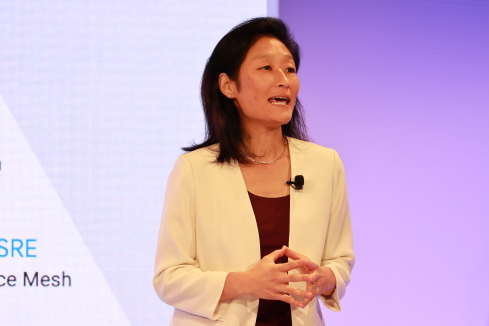 Jennifer Lin, Google Cloud Image: Joao-Pierre S. Ruth What demands are you seeing from organizations that have hybrid environments, and how does Anthos come into play in those circumstances? "The choice today is based on the flexibility moving forward. We started with the on-prem, hybrid scenario with multicloud coming in the future. We know that customers today are already not locking themselves down to one. From a technology perspective, it's not like they can use one management layer easily and get the types of capabilities we're providing through the Kubernetes API server. The fact that Kubernetes is becoming a compute orchestration layer of choice makes it easier for us to say 'if you want to register a cluster that sits in another cloud, today it's in your own prem but tomorrow it could be running in EC2 [Amazon Elastic Compute Cloud] or Azure Cloud'. That is essentially the equivalent to an on-prem server. The compute and storage can sit somewhere else, the intelligent layer managing it across a secure network. "The notion today that from a network perspective you can interconnect two VPCs [virtual private clouds], but it's not at the level of dynamic compute orchestration or a service mesh that extends into another cloud environment or a function that can fire and run in another cloud. Today, lots of people are running Kubernetes in other environments. Istio runs a lot in Azure and AWS. And Knative because these are all open source projects so many of our early adopters are running it in whatever compute environment they want. "After we announced Anthos, some of our competitors were asked specifically what their reaction was. Certain CTOs said they had made it too hard to exit from their cloud. A two- to three-year investment is a big investment. Before it was about thinking about the lowest common denominator. Now if the value is above the infrastructure as a service, we think about this as the service layer. For us the cloud is now value-added above the compute services. How do you monitor the service independent of what the bill of material of the hardware is? How do you think about the intent of the function without knowing in advance the hardware and software environment? You mentioned that there is concern about vendor lock-in. How do you see Anthos as helping to address those concerns? "I think a lot of that is based on open source. A huge number of enterprise customers have gotten to understand Kubernetes, Istio, and Knative just by watching the open source project. When they're ready to move that into a production environment, they want someone else to manage it for them. Being grounded in open source means that if I need to go make another decision, it's easier because it's not tied up in proprietary protocols. We've quickly gotten thousands of ecosystem partners to write to a pluggable architecture that didn't exist before. Even at Google Next, we showed six to seven open source database partners that were exiting out of AWS and coming to Google Cloud because in that case, AWS was competing against them. We've been trying to be very clear about a platform framework that is pluggable -- there are some areas where we have our own database -- but these partners come our way because we're being clear about how we loosely couple these components. "This is based a lot on how Google operates. We have lots of parallel development teams, so we have to be clear about what the interfaces are between different parts of the distributed system. It's not like Sun-Solaris-Oracle where it's all bound within the same hardware and software package, or even Exchange and Office. With Azure originally, they were giving away the cloud to get their renewal of their application layer. We see the next 10 years as more about what really happens above the infrastructure as a service. How do you drive new applications that are using this new architectural framework? I think that's why there's been so much excitement about Kubernetes and what's different about our cloud. What will the push-and-pull be like in the coming 10 years between what you're offering and what the market is calling for? Are we reaching any sort of plateau in development where things settle down? "For enterprise customers, they were thinking about virtualizing and then going to the cloud. Now we're seeing people do that in one step. Maybe don't finish virtualizing but move directly to containers so you have one orchestration layer and then over time modernize the application. That's sort of the Anthos migration story. If you listen to OpenText, they're their own SaaS provider. They've had their own private cloud to serve their customers and they are using us as their platform, so they can go to their customers with one service level agreement. If you think about cloud as making this whole go-to-market very efficient for ourselves. We got into the game very quickly without a huge sales organization. That's because a lot of people like this idea that they can understand it and self-provision it on their own terms without a lengthy sales cycle, channel partners, and integration that is very painful." Joao-Pierre S. Ruth has spent his career immersed in business and technology journalism first covering local industries in New Jersey, later as the New York editor for Xconomy delving into the city's tech startup community, and then as a freelancer for such outlets as ... View Full BioWe welcome your comments on this topic on our social media channels, or [contact us directly] with questions about the site. More Insights  |
| AWS, Azure or Google: Do the differences between cloud providers really matter? - Cloud Tech Posted: 23 Sep 2019 02:22 AM PDT  When evaluating public cloud providers, it is easy to get hung up on the differences. AWS, Microsoft Azure, and Google Cloud each have their own terminology, pricing, service catalog, and purchasing variations. But do these differences ultimately matter? Compute optionsThough we are able to align comparable products across AWS, Azure, and Google Cloud, there are of course differences between these offerings. In fact, with the number of products and services available today (we've counted 176 from AWS alone), comparing each is beyond the scope of this article. For our purposes, we can compare what is still the core product for cloud service providers: compute. Compute products make up about two thirds of most companies' cloud bills, so the similarities and differences here will account for the core of most users' cloud experiences. Here's a brief comparison of the compute option features across cloud providers:
Of course, if you plan to make heavy use of a particular service, such as Function-as-a-Service/serverless, you'll want to do a detailed comparison of those offerings on their own. PricingThat covers functionality. How do the prices compare? One way to do this is by selecting a particular resource type, finding comparable versions across the cloud providers, and comparing prices. Here's an example of a few instances' costs as of this writing (all are Linux OS):
For more accurate results, pull up each cloud provider's price list. Of course, not all instance types will be as easy to compare across providers – especially once you get outside the core compute offerings into options that are more variable, more configurable, and perhaps even charged differently (in fact, AWS and Google actually charge per second). Note that AWS and Azure list distinct prices for instance types with the Windows OS, while Google Cloud adds a per-core license charge, on top of the base instance cost. The table above represents the default On Demand pricing options. However, each provider offers a variety of methods to reduce these base costs, which we'll look at in the Purchasing Options section. TerminologyAt first glance, it may seem like the cloud providers each have a unique spread of offerings. But many of these products and services are quite similar once you get the names aligned. Here are a few examples:
Obviously, this is not a sign of substantive differences in offerings – and just goes to show that the providers are often more similar than it might appear at first glance. Purchasing optionsComparisons of the myriad purchasing options are worth several articles on their own, so I'll keep it high level here. These are the most commonly used – and discussed – options to lower costs from the listed On Demand prices for AWS, Microsoft Azure, and Google Cloud. ReservationsEach of the major cloud providers offers a way for customers to purchase compute capacity in advance in exchange for a discount: AWS Reserved Instances, Azure Reserved Virtual Machine Instances, and Google Committed Use discounts. There are a few interesting variations, for example, AWS offers an option to purchase "Convertible Reserved Instances", which allow reservations to be exchanged across families, operating systems, and instance sizes. On the other hand, Azure offers similar flexibility in their core Reserved VM option. Google Cloud's program is somewhat more flexible regarding resources, as customers must only select a number of vCPUs and memory, rather than a specific instance size and type. What about if you change your mind? AWS users have the option to resell their reservations on a marketplace if they decide they're no longer needed, while Azure users will pay a penalty to cancel, and Google users cannot cancel. Spot and preemptible instancesAnother discounting mechanism is the idea of spot instances in AWS, low-priority VMs in Azure, and preemptible VMs, as they're called on Google. These options allow users to purchase unused capacity for a steep discount. The cost of this discount is that these instances can be interrupted (or perhaps Azure puts it best with their "evicted" term) in favor of higher priority demand – i.e. someone who paid more. For this reason, this pricing structure is best used for fault-tolerant applications and short-lived processes, such as financial modeling, rendering, and testing. While there are variations in the exact mechanisms for purchasing and using these instance types across clouds, they have similar discount amounts and use cases. Sustained use discountsGoogle Cloud Platform offers another cost-saving option that doesn't have a direct equivalent in AWS or Azure: Sustained Use Discounts. This is an automatic, built-in discount for compute capacity, giving you a larger percentage off the more you run the instance. Be aware that the GCP prices listed can be somewhat misleading, as a sustained use discount is already built in, assuming full-month usage – but it is nice to see the cloud provider looking after its customers and requiring no extra cost or work for this discount. ContractsA last sort of "purchasing option" is related to contract agreements. With all three major cloud providers, enterprise contracts are available. Typically, these are aimed at enterprise customers, and encourage large companies to commit to specific levels of usage and spend in exchange for an across-the-board discount – for example, AWS EDPs, Azure Enterprise Agreements. As these are not published options and will depend on the size of your infrastructure, your relationship with the cloud provider, etc., it's hard to say what impact this will have on your bill and how it will compare between clouds. The 'it' factorThere's also just the pure perception of the differences between cloud providers. For instance, some may perceive Azure as a bit stodgy, while Google Cloud seems slick but perhaps less performant than AWS. Some appreciate AWS and Azure's enterprise support more and find Google Cloud lacking here, but this is changing as Google onboards more large customers and focuses on enterprise compatibility. There are also perceptions regarding ease of use, but actually, we find these to be most affected by the platform you're used to using. Ultimately, whatever you're most familiar with is going to be the easiest – and any can be learned. Do the differences really matter?On some of the factors we went through above, the cloud providers do have variations. But on many variables, the providers and their offerings are so similar as to be equivalent. If there's a particular area that's especially important to your business (such as serverless, or integration with Microsoft applications), you may find that it becomes the deciding factor. The fact of the matter is, you're likely to be using multiple clouds soon, if you're not already – so you will have access to the advantages of each provider. Additionally, applications and data are now more portable than ever due to containers. So, prepare yourself and your environment for a multi-cloud reality. Build your applications to avoid vendor lock-in. Use cloud-agnostic tools where possible to take advantage of the benefits of abstraction layers. Even if you're only considering one cloud at the moment, these choices will benefit you in the long run. And remember: if your company is telling you to use a specific cloud provider, or an obscure requirement drives you to one in particular – don't worry. The differences don't matter that much.
Related Stories |


| You are subscribed to email updates from "is there a google cloud" - Google News. To stop receiving these emails, you may unsubscribe now. | Email delivery powered by Google |
| Google, 1600 Amphitheatre Parkway, Mountain View, CA 94043, United States | |

No comments:
Post a Comment