“Google researchers have reportedly achieved “quantum supremacy” - MIT Technology Review” plus 1 more |
| Google researchers have reportedly achieved “quantum supremacy” - MIT Technology Review Posted: 20 Sep 2019 02:51 PM PDT 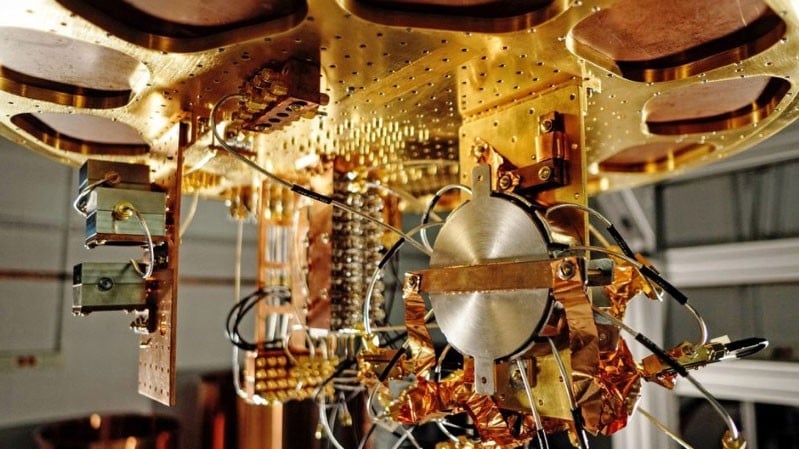 The news: According to a report in the Financial Times, a team of researchers from Google led by John Martinis have demonstrated quantum supremacy for the first time. This is the point at which a quantum computer is shown to be capable of performing a task that's beyond the reach of even the most powerful conventional supercomputer. The claim appeared in a paper that was posted on a NASA website, but the publication was then taken down. Google did not respond to a request for comment from MIT Technology Review. Why NASA? Google struck an agreement last year to use supercomputers available to NASA as benchmarks for its supremacy experiments. According to the Financial Times report, the paper said that Google's quantum processor was able to perform a calculation in three minutes and 20 seconds that would take today's most advanced supercomputer, known as Summit, around 10,000 years. In the paper, the researchers said that, to their knowledge, the experiment "marks the first computation that can only be performed on a quantum processor." Quantum speed up: Quantum machines are so powerful because they harness quantum bits, or qubits. Unlike classical bits, which are either a 1 or a 0, qubits can be in a kind of combination of both at the same time. Thanks to other quantum phenomena, which are described in our explainer here, quantum computers can crunch large amounts of data in parallel that conventional machines have to work through sequentially. Scientists have been working for years to demonstrate that the machines can definitively outperform conventional ones. How significant is this milestone? Very. In a discussion of quantum computing at MIT Technology Review's EmTech conference in Cambridge, Massachusetts this week before news of Google's paper came out, Will Oliver, an MIT professor and quantum specialist, likened the computing milestone to the first flight of the Wright brothers at Kitty Hawk in aviation. He said it would give added impetus to research in the field, which should help quantum machines achieve their promise more quickly. Their immense processing power could ultimately help researchers and companies discover new drugs and materials, create more efficient supply chains, and turbocharge AI. But, but: It's not clear what task Google's quantum machine was working on, but it's likely to be a very narrow one. In an emailed comment to MIT Technology Review, Dario Gil of IBM, which is also working on quantum computers, says an experiment that was probably designed around a very narrow quantum sampling problem doesn't mean the machines will rule the roost. "In fact quantum computers will never reign 'supreme' over classical ones," says Gil, "but will work in concert with them, since each have their specific strengths." For many problems, classical computers will remain the best tool to use. And another but: Quantum computers are still a long way from being ready for mainstream use. The machines are notoriously prone to errors, because even the slightest change in temperature or tiny vibration can destroy the delicate state of qubits. Researchers are working on machines that will be easier to build, manage, and scale, and some computers are now available via the computing cloud. But it could still be many years before quantum computers that can tackle a wide range of problems are widely available.  |
| Daily API RoundUp: Google Cloud Web Risk, CheckWX, Nuki, iSports - ProgrammableWeb Posted: 14 Sep 2019 12:45 PM PDT Every day, the ProgrammableWeb team is busy, updating its three primary directories for APIs, clients (language-specific libraries or SDKs for consuming or providing APIs), and source code samples. If you have new APIs, clients, or source code examples to add to ProgrammableWeb's directories, we offer forms (APIs, Clients, Source Code) for submitting them to our API research team. If there's a listing in one of our directories that you'd like to claim as the owner, please contact us at editor@programmableweb.com. Eleven APIs have been added to the ProgrammableWeb directory in categories including Security, Weather, and Internet of Things. Highlights include the W3C Badging API for enabling users to see new activity about an application on a home screen. Here's a rundown of the latest additions. APIs Google Cloud Web Risk is a service for developers to check URLs against unsafe web resources. The Google Cloud Web Risk Lookup APITrack this API checks for malicious web sources and enables users to be warned before they click or post infected links. The Google Cloud Web Risk Update APITrack this API allows developers to download hashed lists of unsafe resources such as phishing sites or malware hosts for storage in a local database. If a match is found with the local database, the client can request verification from the Web Risk API servers to confirm the URL's presence on the unsafe lists. Both APIs are listed in Security. CheckWX is a tool to help pilots better visualize weather data. The CheckWX APITrack this API returns aviation weather in JSON and XML formats. The API includes methods for stations, METeorological Aerodrome Reports (METARs), and Terminal Aerodrome Forecasts (TAFs). Developers can implement a station field, station radius, station latitude, and longitude. It is filed under the Weather category. iSports API is a provider of sports data. Developers looking to implement football (soccer) data into applications can use the iSports football API and retrieve live scores, lineups, schedules, results, player information, odds and other information for more than 1400 leagues and cups. The API is filed under Sports. Captcha.guru provides reCAPTCHA and antiCAPTCHA services. With the Captcha.guru APITrack this API, developers can use an image that contains distorted but human-readable text. To solve the CAPTCHA, the user has to type the text from the image. The API supports JSON formats and is listed in the Captcha category. Nuki is a provider of keyless electronic door locks (smart locks). The Nuki Web APITrack this API provides access to smart lock solutions for iOS and Android devices. Developers can send commands through an HTTPS/TLS connection, forming a bridge and forwarding actions via Bluetooth. They can authentication bearer to make calls that will display JSON in return. The Nuki Bridge HTTP APITrack this API can access door openers, current lock states, and lock operations. By calling the URL, developers receive JSON arrays with bridges that include IP address, port, bridge ID, and day of last entry. The APIs are listed in the Internet of Things category. Nuki Smart Lock 2.0 - Turn your smartphone into an intelligent key Video: YouTube/Nuki Smart Lock Hansard is the edited verbatim official report of proceedings of both the House of Commons and the House of Lords for The Parliament of New South Wales. The Hansard APITrack this API provides an open way to consume Hansard documents and metadata, including information for sitting dates, members, bills, and more. The Hansard API is listed under the Government category. See ProgrammableWeb's complete list of Government APIs. SmartPension is a service for automatic enrollment of workplace pensions. The SmartPension APITrack this API returns JSON data with pension details for employees. With the API, developers can implement contributions, companies, referrals, enrollments, bills, advisers, and staging dates. The API is listed in the Human Resources category. W3C Badging APITrack this API describes the process to set an application-wide badge without showing a more heavyweight notification. Badges can be shown on the home screen to notify the user when the state of the application has changed. This is useful for displaying how many new messages have arrived. The Badging API is listed under the Notifications category. See ProgrammableWeb's complete list of Notifications APIs.  The Badging API can be used to notify users from other places that new events have occured in applications. Image: Google  |
| You are subscribed to email updates from "google cloud download" - Google News. To stop receiving these emails, you may unsubscribe now. | Email delivery powered by Google |
| Google, 1600 Amphitheatre Parkway, Mountain View, CA 94043, United States | |

No comments:
Post a Comment